Agentic Experience [Part 3]: Two Roles that will redefine Marketing


That is Theodore Twombly with his friend Amy in the film ‘HER’. They are both sitting at BeautifulHandwrittenLetters.com, where Theodore is more than the company’s top writer; he is an emotional architect who interprets his clients’ human relationships and nuances to write personal letters on their behalf, to deliver an emotional experience to his clients’ recipients.
Today, Large Language Models (LLMs) perform what Theodore is best at, as LLMs are the invisible layer that interprets our feelings or conversational prompts in AI systems like Chat GPT or Claude, which then deliver an elegant, poetic and emotionally charged letter, presentation or just an answer to our question about which is the best hydrating or moisturising product for our skin type.

Products and brands are aware of this, and how product pages, reviews and content need to be crafted and optimised for LLMs to recommend your brand in those AI systems. This has given rise to a new role called Generative Engine Optimisation (GEO), the discipline that ensures brand content is indexed, understood, trusted and cited by LLMs and therefore, AI systems.
Now, let’s speak about Amy. She is a creative professional in the audiovisual media, producing a documentary about her mother. Like Theodore, who seeks companionship after his painful divorce and meets Samantha, an AI system that becomes something more than just that, Amy develops a different relationship with an AI system. She integrates it into her life without being dependent on it.
In the Agentic Experience [Part 1], I mentioned how companies are reacting to this whole new Agentic Experience paradigm without a clear strategy, creating a structural dependency with new AI intermediaries that are shaping discovery, aggregating intent, context and decision signals, and effectively owning the layer of decision intelligence that once belonged to the organisation, eroding the company’s long-term competitiveness.
In other words, companies have been investing heavily in building a MarTech stack with AI to hyper-personalise clients’ experience. An average of 15 to 50 tools, bottlenecks, fragmented systems and uncontrolled decisions without governance, leading to customer fatigue, decreased ROI, and associated technical debt, in most cases. Now, the Agentic Experience is right here, bringing with it its own unresolved challenges.

Amy clearly shows a healthy attitude toward AI. She engages with it, she explores it, but she does not outsource her identity to it. She is a reminder of what shouldn’t be fully delegated or automated by Agents or systems (that can interpret, generate, predict and act on our behalf).
She embodies authentic perception, creative intention, ethical and emotional grounding; the foundational principles of a Marketing Architect, the new role along GEOs, that will redefine Marketing in this Agentic Era.
Let’s dive into the characteristics and challenges of these new roles:
The GEO: When Visibility Means Being Part of the Answer
Generative Engine Optimisers, or GEOs, help brands and products appear within generated answers. They are the guardians of AI visibility and are responsible for structuring content so that AI can interpret and trust it.
But there’s more. They need to manage consistency across data sources that feed AI cognition. They monitor the share of voice in different AI-generated answers to ensure that the brand or products are cited correctly as credible sources in the decision-making process. Therefore, GEOs don’t optimise for traffic. They optimise for influence.
A new initiative in this space comes from L’Oreal US. They have introduced product try-ons on ChatGPT using augmented reality (AR) technology. If you like the product, ChatGPT helps you connect directly to major US retailers to complete the purchase.
A smart and creative move via integrations and APIs with what is known as the ‘Agentic Commerce Protocol’ or ACP: a protocol that sits at the intersection of Agents and interoperability. It is made of rules, interfaces and interaction standards, and it enables agents to autonomously discover, negotiate and transact with each other on behalf of users and organisations. For example, agents can talk with other agents to complete transactions without human intervention.
And this is precisely the invisible part of the Agentic Experience, yet the most important one. How is data processed between agents and systems? How do solutions and agents integrate in this Agentic Experience? And how is transparency and decision-making governed?
Let’s face it. If OpenAI or ChatGPT becomes the “front door” controlling discovery, ranking and recommendation logic, aren’t retailers, telcos or financial institutions at risk of becoming suppliers within the AI ecosystem? And where is customer data and decision intelligence heading? 🤷♀️
That’s where the new role of the Marketing Architect comes in, to turn things around creatively, from a business infrastructure standpoint.
The Marketing Architect: When the Invisible is the most important Part
Marketing Architects ensure that business infrastructure is effective, optimised, resilient, secure, and well executed. They maintain a 360-degree view of the entire business ecosystem, including interconnections, software, cloud services, environments, and integrations.
This requires a systems-thinking mindset applied to marketing and the broader business context. It does not necessarily demand a deep technical expertise, but rather a strong strategic perspective. Despite its importance, this role is not clearly defined or widely recognised within organisations.
For example, a Marketing Architect might oversee the implementation of a conversational assistant within an app to build customer trust through personalised recommendations, tips and advice. They are not responsible for designing the assistant itself, but for defining its intent, business logic, trust protocols, desired outcomes and things to avoid.
Therefore, they don’t emerge to compete with agents, but to design the purpose, mission and meaningful integration of the business infrastructure ecosystem within which systems, channels, and agents should operate inside the organisation, building long-term competitiveness and trust.
That’s why the GEO and the Marketing Architect need to work closely together. Their collaboration ensures that content is properly indexed and connected to the organisation’s brand equity infrastructure. Without alignment, organisations risk creating fragmented messaging, tools and inconsistencies (again)

The partnership is highly disruptive and valuable for organisations. If these roles operate in isolation, developing their own initiatives and tools, this will lead to an internal competition for visibility rather than cohesion. It’s a competitive horsepower to solve the challenges of hyper-personalisation architecture, and the new wave of Agent solutions on top of the existing stack:
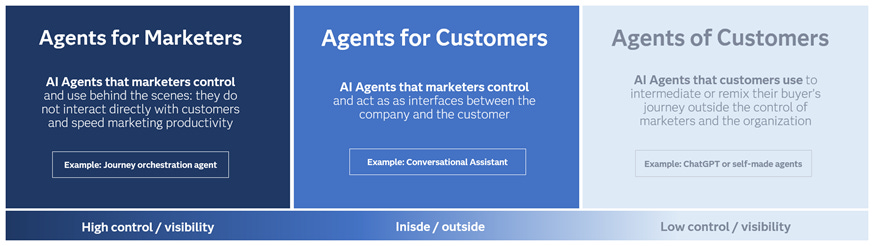
The great challenge of the Marketing Architect
The challenge now is to navigate a new layer of agent-driven solutions superimposed on top of an already complex and fragmented marketing stack. And of course, to avoid the mistakes of the past.
Today, agents are being deployed in silos with disconnected data and logics, and without a strong-governed AI foundation. The consequences of getting it wrong are devastating: brand inconsistency, autonomous and uncontrolled decisions…
That’s why I love Amy. She and Theodore have different trust issues with AI. Whilst Theodore blindly believes in AI, Amy doesn’t let AI control her. She asks what the AI system is doing to build long-term success through meaningful human-centred and integrated orchestration.